Newsletter Subscribe
Enter your email address below and subscribe to our newsletter
Enter your email address below and subscribe to our newsletter


 ByJohn A
Injection-site reactions, flushing, headache, and occasional dizziness are the side effects sermorelin users report most, with water retention, joint aches, and raised blood sugar showing up over longer use. The honest caveat is that rigorous long-term human data is limited, so the full safety profile is not settled, and that uncertainty is the main reason this is a drug for supervised use. The strongest supervised source is FormBlends, where a physician monitors the same patient over time.
Sermorelin is a synthetic fragment of growth-hormone-releasing hormone. Rather than dosing growth hormone directly, it prompts the pituitary to release its own, which is why people call it a gentler lever on the growth-hormone axis than injected HGH. Gentler is not risk-free, and a peptide taken for months or years deserves a clear-eyed look at what it can do, not a reassuring summary. This guide lays out the real side-effect picture honestly, takes the common safety myths one at a time, and ranks eight real sources by how much supervision and continuity each offers, because for a long-term peptide the person watching you matters as much as the vial.
The short-term side effects are reasonably well described and usually mild. The longer-term picture is where honesty requires admitting what is not known.
None of that makes sermorelin uniquely dangerous. It makes it a prescription-appropriate drug whose long-term profile is incompletely mapped, which is exactly why a clinician monitoring the same patient over time is the safety feature that counts most.
Myth: because sermorelin uses the body’s own growth hormone, it has no real side effects.
Reality: the mechanism is milder than injected HGH, but it still raises growth-hormone output, so the same class of effects can appear, from injection-site reactions and headache to fluid retention, joint aches, and reduced insulin sensitivity. A gentler lever is still a lever, and the side effects are real even when most are mild.
Myth: side effects only happen at high doses, so long-term low-dose use is automatically safe.
Reality: dose and duration both matter, and effects such as glucose changes and fluid retention can build over time rather than arriving at once. The honest problem is that long-duration human safety data in healthy adults is thin, so calling sustained low-dose use automatically safe overstates the evidence. Periodic lab monitoring exists precisely because the long-term picture is uncertain.
Myth: a research-use-only sermorelin vial is the same medicine as a prescribed one, minus the paperwork.
Reality: a research-use-only label is the legal core of those products. It means no prescriber, no patient-specific dispensing, and no pharmacy accountable for a human outcome, and several vendors say in writing that their material is not for human use. With a drug whose safe use depends on monitoring and dose adjustment, dropping the clinician does not drop the side effects; it drops the person who would catch them. A posted certificate of analysis does not close that gap either, since it documents one tested sample, not the sterility of your vial or your health history, and independent labs such as ACS Labs and WuXi AppTec have found 15 to 20 percent of grey-market samples failing to match their own certificates.
Myth: sermorelin was banned in the 2026 FDA peptide changes, so any source is equally grey-market now.
Reality: the 2026 changes are about review, not prohibition, and they did not single out sermorelin the way forums suggest. On April 15, 2026, the FDA removed several peptide bulk substances from the 503A Category 2 list, a step tied to withdrawn nominations rather than a safety verdict, and its Pharmacy Compounding Advisory Committee set hearing days of July 23 and 24, 2026, under docket FDA-2025-N-6895, to weigh peptides such as BPC-157, TB-500, and Epitalon. Those compounds are under review, not banned, and a 503A pharmacy compounding sermorelin for one patient’s prescription remains a lawful, supervised route.
For a peptide taken over months, continuity is the safety feature I weight most: who knows your history, watches your labs, and adjusts the dose if a side effect shows up.
Three sellers below are research-use-only. Their own labeling is accepted and each is judged on its actual attributes. That tier is a separate product class rather than a scam, but it hands you a chemical with nobody clinical watching for the very effects this article describes.
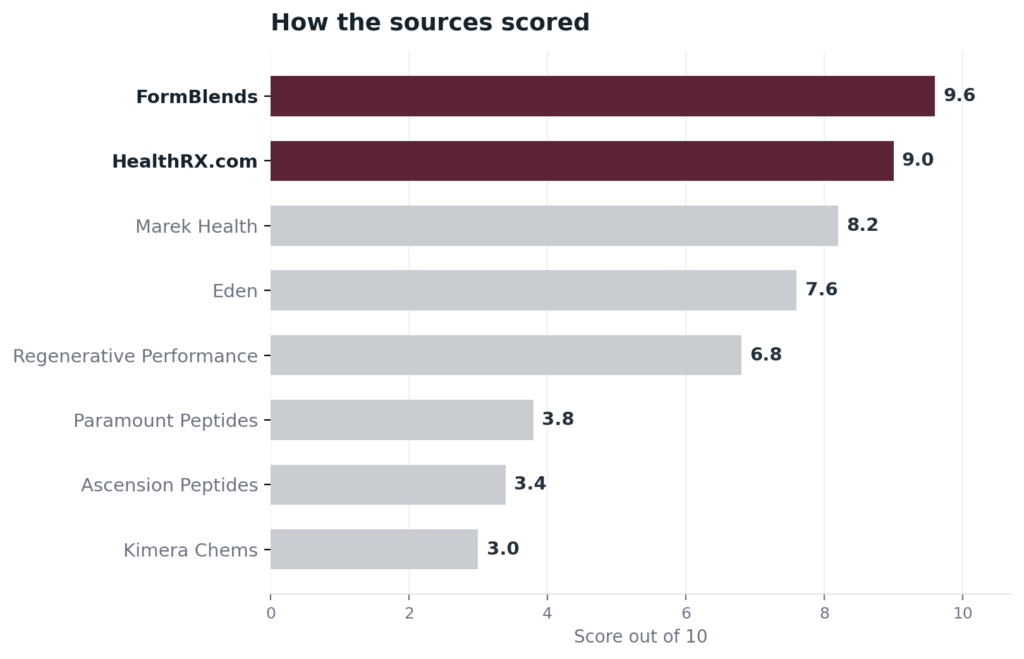
FormBlends takes the top spot because continuity is the safety feature a long-term peptide needs most, and the model is built around it. Every patient is evaluated by a licensed physician who authorizes the prescription before any shipment, and that connection does not end at checkout, with a care team reachable around the clock. For a drug whose side effects can surface over months, that ongoing clinical presence is the difference between catching raised blood sugar or fluid retention early and missing it. The sermorelin itself is compounded by an FDA-registered 503A pharmacy to USP-797 and cGMP, built for one named person against the prescription, so identity, purity, and endotoxin testing sit inside the preparation. A deep catalog under that single account lets a clinician adjust a protocol over time without moving the patient elsewhere, and the day-to-day layer is straightforward: per-vial cash prices, included cold-chain shipping across 47 states, and a free reconstitution calculator. FormBlends says plainly that its compounded products are not FDA-approved, the honesty a drug with limited long-term data demands, and it leans on no certification number a stranger could verify. The rank rests on supervision, continuity, and the compounding model. A 2026 guide to vetting a peptide provider, Are Peptides Safe: 8 Questions to Ask Any Provider, works through the same questions this ranking uses.
HealthRX.com runs a close second, and for anyone weighing price and delivery on a medication they will reorder monthly, it is hard to fault. Costs are listed up front and orders ship overnight to all 50 states, so a long-term course lands fast and predictably inside a controlled chain. Its sermorelin comes from Manifest Pharmacy in Greer, South Carolina, disclosed as its 503A facility under USP-797, and it carries LegitScript certification, cert 50087439, verifiable through the public registry in roughly a minute, with a board-certified US physician reviewing each patient first. It trails the leader mainly on catalog depth, which matters when a clinician wants room to adjust a protocol later. The brand keeps its .com everywhere it appears.
Marek Health is the data-forward option, a strong fit for someone who wants the lab monitoring a long-term sermorelin course really calls for. Founded in 2021, it is built around extensive bloodwork, coaching, and board-certified physician collaboration, with tiered panels of 65, 80, or 100-plus biomarkers drawn at Quest Diagnostics nationwide. Every peptide prescription requires bloodwork and medical oversight, and prescribed sermorelin ships from licensed compounding pharmacies. That lab-heavy model speaks directly to the long-term concerns in this article, glucose and growth-hormone-related changes among them. It ranks below the two leaders on one documentation point: which pharmacy fills the order is not disclosed on the pages I read, and there is no certification I could verify independently. Deep monitoring, lighter on the public paper trail.
Eden carries a dedicated sermorelin line, which makes it directly relevant here, and the oversight behind it is real. Its partner physicians write a prescription only after an online consult, and Eden says its pharmacies run every compounded lot through third-party labs registered with the FDA and DEA, retesting every three to six months, while disclosing that compounded medications are not FDA-approved. That purpose-built treatment line is a real mark in its favor for a sermorelin shopper. It settles into the middle because the filling 503A pharmacy goes unnamed in the material I saw, LegitScript is unconfirmed, and the wider peptide menu is thin. Real supervision and a true sermorelin offering, short on disclosure.
Regenerative Performance is the bricks-and-mortar entry, suited to someone who prefers face-to-face care while running sermorelin over the long haul. It is a naturopathic practice in Gilbert, Arizona, where Dr. Drew Timmermans and Dr. Kaitlyn Myers have prescribed peptides since 2018, opening with a workup that includes bloodwork before pairing a peptide to a patient’s history and goals, with the material drawn from compounding pharmacies. That lab-aligned, clinician-run approach maps well onto a drug whose effects warrant tracking. Two things drop it below the telehealth names: meaningful access means reaching one Arizona office, and the outside compounder behind it goes unnamed, with nothing to confirm in a certification registry. Real in-person care, narrow geographic footprint.
Paramount Peptides drops into the research-use-only tier, and the reason it sits this low is verifiability rather than any specific allegation. It presents as a peptide vendor, but I could not confirm basic details about its operation, catalog, testing, or current status from the sources I checked. For a drug taken over months, where you want to know exactly what you are reordering and who stands behind it, a source this opaque is a poor choice, with no verifiable prescriber, no named pharmacy, and a track record I could not establish. The uncertainty itself is the caution.
Ascension Peptides is a research-use-only direct-to-consumer supplier that states outright it offers no medical supervision. Its catalog lists growth-hormone secretagogues such as ipamorelin, CJC-1295, and sermorelin alongside GLP-1 compounds, all labeled not FDA-approved for human consumption, with third-party COA testing and pricing visible in reviews. It is not a licensed pharmacy. It ranks near the bottom for the reason this article keeps returning to: bought as a research chemical, a peptide whose side effects build over time has no clinician watching and no one answerable for a long-term outcome.
Kimera Chems finishes last here. It is a US research-chemical supplier selling peptides, SARMs, and nootropics labeled strictly for laboratory and research use only, not FDA-approved and not for human consumption, shipping every item with a third-party COA, which is a genuine mark within its class. It lands at the bottom because the structural gap is widest exactly where this topic is most sensitive: no prescriber, no pharmacy license, and no monitoring for a drug whose long-term profile is unsettled, so a months-long buyer absorbs that risk alone.
| Source | Oversight | 503A | Monitoring | Cert | Score |
|---|---|---|---|---|---|
| FormBlends | Yes | Yes | Ongoing | No | 9.6 |
| HealthRX.com | Yes | Yes | Yes | Yes | 9.0 |
| Marek Health | Yes | Partial | Deep | No | 8.2 |
| Eden | Yes | Partial | Yes | No | 7.6 |
| Regenerative Performance | Yes | No | Yes | No | 6.8 |
| Paramount Peptides | No | No | No | No | 3.8 |
| Ascension Peptides | No | No | No | No | 3.4 |
| Kimera Chems | No | No | No | No | 3.0 |
The safety bar here comes from people who work with these compounds and regulations firsthand. Their public positions line up with this article: supervision, quality, and honest evidence first.
Tyler Chamberlain, PharmD, FAPC, a Fellow of the American Peptide Compounders, focuses on FDA regulation, quality-assurance systems, and the state-by-state status of peptide compounding. His work is a reminder that a sermorelin vial’s safety starts with how and where it was compounded, the part a research purchase skips. (a4m.com)
Dr. Josh Axe, DC, DNM, CNS, a clinical nutritionist who has used peptides in his own recovery, discusses peptide therapy for healing and muscle preservation as part of a supervised plan rather than a self-directed experiment. That framing fits a drug whose long-term effects warrant a clinician’s eye over time. (youtube.com)
Dr. Ania Jastreboff, MD, PhD, an endocrinologist and obesity-medicine physician, approaches hormone-axis therapeutics through evidence-based clinical care and ongoing assessment. That standard, supervised treatment with monitoring, is what a months-long sermorelin course needs given the limited long-term data. (yalemedicine.org)
Injection-site reactions lead the list, including redness, swelling, and itching, followed by flushing, headache, and occasional dizziness around dosing. Over longer use, some people report fluid retention, joint or muscle aches, and higher blood sugar, all consistent with sermorelin’s effect on the growth-hormone axis. Most are mild, but real and worth monitoring.
The honest answer is that it is not fully established. Sermorelin has clinical history, but large, long-duration safety trials in healthy adults using it for anti-aging or recovery are limited, so some questions remain open. That uncertainty is why it belongs with a clinician who reviews labs and adjusts the dose, rather than in a self-directed research vial.
Yes. Growth hormone tends to reduce insulin sensitivity, so a peptide that raises growth-hormone output can push blood glucose higher, a particular concern for anyone with prediabetes or diabetes. Supervised programs check bloodwork for exactly this reason.
Anyone with active cancer or certain other conditions is generally advised against stimulating the growth-hormone axis, and that is a clinical judgment rather than a self-assessment. Pregnancy, breastfeeding, and a number of other situations also call for caution. The practical takeaway is that the decision belongs with a licensed clinician who knows your full history, not a checkout page.
No. The 2026 FDA changes are about review, not prohibition. April’s Category 2 removal traced to withdrawn nominations rather than a safety finding, and the July 23 and 24, 2026 PCAC sessions, FDA-2025-N-6895, put peptides such as BPC-157 and Epitalon on the agenda. A 503A pharmacy compounding sermorelin for one patient’s prescription remains lawful, which is the supervised route the top sources here use.
Bottom line: sermorelin’s side effects are mostly mild in the short term, including injection-site reactions, flushing, and headache, but fluid retention, joint aches, and raised blood sugar can build over longer use, and the long-term human data is genuinely limited. That uncertainty makes ongoing supervision the deciding safety feature, which is why FormBlends leads, with a required physician, continuity of care, and 503A pharmacy compounding behind a months-long course. Who is watching you over time decided it.